💬 Famous Quotes
📋 Basic Information
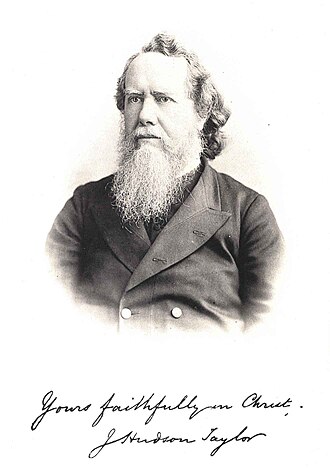
📖 Biography
James Hudson Taylor (21 May 1832 – 3 June 1905) was a British Protestant missionary to China and the founder of the China Inland Mission (today the Overseas Missionary Fellowship, OMF). He spent 51 years in China. The mission he founded sent more than 800 missionaries and established 125 schools, and set up more than 300 mission stations (“stations of work”) in 18 provinces with the participation of more than 500 local assistants; by around 1910 the mission had led more than 20,000 Chinese to the Christian faith.
Hudson Taylor was known for his sensitivity to Chinese culture and his zeal for mission. At a time when very few missionaries wore Chinese clothes, he already did. Under his leadership the China Inland Mission became a prominent non-denominational mission, taking in members from all Christian bodies and from the working classes, single women and people of different nationalities. Because of the mission's campaign against the opium trade, Hudson Taylor was regarded in the West as the most notable European in China since the 19th century. The historian Ruth Tucker summed up his life: “Since the Apostle Paul, of all who, holding ‘a vast vision, carried out step by step,’ have spread the gospel over so wide a territory, in the nineteenth century Hudson Taylor stands first.”
Early Years
Hudson Taylor was born in Barnsley, Yorkshire, England. His father, James Taylor (戴雅各), was a pharmacist and a Methodist lay preacher; his mother was Amelia Hudson (贺美亚). In his youth Hudson Taylor turned away from his parents' Christian faith. In 1849, at the age of 17, after reading a gospel tract, he resolved to turn to Christ, and in December of the same year he decided to give himself to going to China as a missionary. At this time he came into contact with Dr Edward Cronin, one of the first Plymouth Brethren missionaries to Baghdad. It is generally believed that Taylor learned his “faith mission principles” (“faith principles” for short) through his contact with the Brethren. He also borrowed and diligently studied Medhurst's (麦都思) China: Its State and Prospects, and at the same time began to learn Chinese, Greek, Hebrew and Latin.
In 1851 he moved to a poor district of Hull, working as medical assistant to Dr William Hardey. This was also a preparation and training for his later life of faith and ministry: giving himself to poverty and trusting God to supply all his needs. There he became practised in distributing gospel tracts among the poor and in open-air preaching. He also came into contact with the Brethren again, this time with Andrew Jukes, a well-known Brethren teacher in Hull.
In 1852 Hudson Taylor began studying medicine at the Royal London Hospital in Whitechapel, London, in preparation for work in China. At that time a wave of enthusiasm for China was rising in Britain. It arose partly because the British mistakenly believed that the Taiping Rebellion was a large-scale movement to Christianize China, and partly from the missionary Gützlaff's (郭实腊) exaggerated claims that China was open. Hudson Taylor therefore joined the Chinese Evangelisation Society, which had been founded under Gützlaff's influence, becoming its first missionary.
First Journey to China
On 19 September 1853 the 21-year-old Hudson Taylor, sent by the Chinese Evangelisation Society, set sail for China. On 1 March 1854 (the 22nd day of the 1st month of the 4th year of Xianfeng) he landed at Shanghai and first preached in the area around the city. This was while the Taiping forces and the Qing army were fighting at Shanghai, and bullets whistled over his head. Although he had been prepared to suffer, he had not expected to face the dangers of war. Caught in the middle, he saw with his own eyes the folly of the sinful human heart and the cruelty of war.
Hudson Taylor learned Chinese, but he soon found that his methods of mission were limited: many people did not listen attentively to his preaching and showed no interest in the gospel books and tracts he handed out. When he preached in the street in Western clothes, people kept staring at what he was wearing. He decided to change to Chinese clothes, grow a queue and eat Chinese food, to show respect for Chinese culture and identify with the local people, so as to lessen racial distinctions and remove conflict. When he put this new idea into practice, it caused a considerable stir in foreign circles.
In 1855 (the 5th year of Xianfeng) Hudson Taylor met the Scotsman William Chalmers Burns (1815–1868) in Shanghai. Burns was a well-known evangelist in Britain and the first missionary of the English Presbyterian Church to China. He was 17 years older than Hudson Taylor and had already been in China for seven or eight years, an experienced hand. Hudson Taylor regarded Burns as a spiritual father, and the two got on very well. Once they heard a Christian sea captain, Captain Bowers, speak of the need for the gospel in Shantou (Swatow), Guangdong; both were moved, and Bowers gave them free passage. After arriving in Shantou the two rented a simple little house together and went out together to preach. Later the local official fell ill and could not be cured for a long time; hearing that Hudson Taylor could treat illness with Western medicine, he asked him to try, and he soon recovered. In gratitude he helped them, and their working and living conditions greatly improved. The two felt that a partnership in which Burns preached and Hudson Taylor treated the sick was a good way to spread the gospel. So Hudson Taylor went back to Shanghai to fetch the medicines and equipment he had left there; but on returning he found that most of his equipment had been destroyed by fire and the rest had been stolen by a Chinese servant. Soon afterwards he received a letter from Burns: two Chinese Christian co-workers had been put in prison for preaching the gospel, and Burns himself was being held by the British consul in Guangzhou (Canton) and warned not to preach at will.
In October 1856 (the 9th month of the 6th year of Xianfeng) Hudson Taylor went to Ningbo, Zhejiang, to assist Dr William Parker. In June 1857 he resigned from the Chinese Evangelisation Society and worked independently in Ningbo (the so-called “Ningbo Mission”), afterwards receiving support from George Müller and others. He preached at Huqiaotou (湖桥头, on Liuting Street, 柳汀街). The Huqiaotou church was later named Huaide Church (怀德堂); its original site lies within today's Moon Lake Park (月湖公园), east of Ludian Bridge (陆殿桥).
In Ningbo an Englishwoman, Miss Mary Ann Aldersey, had opened the first Protestant girls' school in China. The orphaned daughters of the Rev. and Mrs Dyer (台约尔), the sisters Burella Hunter Dyer (31 May 1835 – August 1858) and Maria Jane Dyer (16 January 1837 – 23 July 1870), had come to Ningbo in 1853 (the 3rd year of Xianfeng) to help Aldersey run the school. On 20 January 1858 (the 6th day of the 12th month of the 7th year of Xianfeng), Hudson Taylor married the 21-year-old Maria Dyer in Ningbo.
In August 1858 (the 7th month of the 8th year of Xianfeng), Dr Parker's wife died suddenly of cholera. The grieving Parker decided to take his children back to Britain to be brought up by their grandparents, and Hudson Taylor took over the work of the hospital and dispensary.
The China Inland Mission
On 18 July 1860 (the 1st day of the 6th month of the 10th year of Xianfeng) he set out from Shanghai to return to Britain, partly to rest, because his health had broken down, and partly because he hoped to complete his medical training to the level of a formal diploma. While in Britain he qualified as a Member of the Royal College of Surgeons (MRCS); later he also became a Fellow of the Royal Geographical Society (FRGS). This period can be called Hudson Taylor's wilderness years: he prayed constantly, shared his burden for mission in China wherever he went, and thought deeply about the strategy and direction of mission in China.
In late June 1865 Hudson Taylor was on holiday at the seaside in Brighton, in the south of England. On 25 June, walking on the beach, he thought again of the multitudes in China who needed to be saved and was consumed with anxiety; receiving God's comfort and revelation, he asked God to prepare 24 missionaries to go with him to China. After returning to London from Brighton, he deposited a small sum of ten pounds in a bank in the name of the China Inland Mission, marking the founding of the mission. On 25 October 1865 Hudson Taylor published a booklet, China's Spiritual Need and Claims, pointing out that 33,000 people were dying in China every day and a million every month, perishing because they did not have Christ's salvation. Although China had signed the Convention of Peking and missionaries were free to go into the interior to preach, most Western missionaries were still concentrated in the five treaty ports on the coast, and 11 inland provinces had never been entered by a missionary. The principle of the China Inland Mission was therefore to call missionaries willing to go into inland China; their first aim was to have at least one missionary couple stationed in every province of China.
In September 1865 Hudson Taylor attended a Christian conference for the spiritual life in Scotland and shared a message with the gathering from Proverbs 24:11-12: “Rescue those who are being led away to death! Indeed, hold back those who are staggering to the slaughter!” In October, at the Mildmay Conference, he distributed his booklet China's Spiritual Need and Claims, which had considerable influence. In October 1865 Hudson Taylor sent George Stott and John and Ann Stevenson to Ningbo, Zhejiang, to join the 5 men and women missionaries already there: James and Martha Meadows (1862; Mrs Meadows died the following year), Miss Jean Notman (1864), Stephan Paul Barchet, George Crombie and Anne Skinner. With this, the China Inland Mission had 8 pioneers already in China.
In 1866 Hudson Taylor selected 16 men and women who had applied: Lewis and Eliza Nicol, George Duncan, William David Rudland, Josiah Alexander Jackson, James Williamson, John Robert Sell, Emily Blatchley, Jennie Faulding, Mary Bowyer, Mary Elizabeth Bausum, Susan Barnes, Mary Bell, Louise Desgraz, Jane McLean and Elisabeth Rose. On 26 May Hudson Taylor and his wife, with their four children, left Britain with these 16 missionaries on the sailing ship Lammermuir; they became known as the Lammermuir Party. In October 1866 (the 9th month of the 5th year of Tongzhi) the first China Inland Mission missionaries arrived in China. The first mission station they chose was Hangzhou, the provincial capital of Zhejiang; from this base the work spread rapidly to many cities in Zhejiang, especially Wenzhou in the south. The first church the China Inland Mission built in China, Chongyi Church (崇一堂), stood on Xinxiang Lane (新巷) off Qingtai Street (清泰街) in Hangzhou; it was rebuilt on a new site in 2005, seats about 5,500 people, and is one of the largest church buildings in China.
The China Inland Mission later became a model for “faith missions” and for inland missions around the world. Western mission history treats him as a dividing line, which shows Hudson Taylor's importance and standing in the missionary movement. The mission's “Faith Principle” meant doing the work God called them to by faith. When they were short of funds they did not appeal publicly for money, but let God move people to help meet their needs.
In August 1868 (the 7th month of the 7th year of Tongzhi), Hudson Taylor arrived in Yangzhou, Jiangsu, a strategic city where the Yangtze meets the Grand Canal, planning to make it a base for spreading the gospel to central and northern China. On 22 August the China Inland Mission station on Pishi Street (皮市街), Yangzhou, was attacked, looted and set on fire by a mob of over ten thousand, and Hudson Taylor's pregnant wife Maria was injured jumping from an upper floor to escape. This was the well-known Yangzhou riot (扬州教案).
In 1870 (the 9th year of Tongzhi) his beloved wife Maria died of illness. In 1871 (the 10th year of Tongzhi) he married Jennie Faulding, a woman missionary who had come to China on the same ship.
In 1887 (the 13th year of Guangxu) another 102 missionaries joined the China Inland Mission. By the end of the 19th century the mission had become the largest missionary society in China. Before Hudson Taylor's death its missionaries had grown to 828, from Britain, the United States and the Nordic countries, spread across eighteen provinces of China, reaching Mongolia in the north, Xinjiang in the northwest and Yunnan in the southwest.
Death and Burial
On 3 June 1905 (the 1st day of the 5th month of the 31st year of Guangxu), Hudson Taylor died in Changsha, Hunan; Dixon Edward Hoste (何斯德) had already succeeded him as General Director of the China Inland Mission in 1903. His coffin was taken to Zhenjiang and buried in the foreign cemetery at Niupipo (牛皮坡) beside the Yangtze, together with his first wife Maria and 4 of their children. The inscription on the gravestone reads: A MAN IN CHRIST. Below it, a Chinese inscription set up in 1931 by Herbert Hudson Taylor (戴存仁) and his wife reads: “Though he is dead, by faith he still speaks.” In 1966, during the Cultural Revolution's campaign against the “Four Olds,” the cemetery was destroyed without trace, and houses were built on the site. Hudson Taylor's gravestone was kept by museum staff in a corner of the Zhenjiang Museum, which occupies the former British Consulate in Zhenjiang. In 1983 Jim Taylor (戴绍曾) went to Zhenjiang, found the gravestone and moved it to the Daxi Road Gospel Church (大西路福音堂) for safekeeping. In 2013, when the original cemetery site was redeveloped as a housing estate, archaeologists excavated the grave of Hudson Taylor and his wife intact. On 15 April 2014 the grave was moved to the basement of the bell tower planned at the new Xuande Church (宣德堂) on Jiuhuashan Road (九华山路), Dantu District, Zhenjiang, and the bell tower was named the Desheng Building (德生楼). While the Desheng Building, the Hudson Taylor memorial hall, was still under construction, Hudson Taylor's gravestones were also moved to Xuande Church (July 2016): one stands outdoors (under a cloth cover) and the other is in the basement of the memorial hall. On 5 June 2018 the Desheng Building memorial hall was formally opened.
Influence
Hudson Taylor's “faith principle” had a wide influence on later evangelical churches. Well-known examples include the Olympic gold medallist and missionary Eric Liddell and the evangelist Billy Graham. The China Inland Mission also became one of the largest Protestant mission societies in the world.
Anecdotes
Sayings of Hudson Taylor. Hudson Taylor left many sayings that encourage missionaries and Christians:
- “If I had a thousand pounds China should have it—if I had a thousand lives, China should have them. No! Not China, but Christ. Can we do too much for Him? Can we do enough for such a precious Saviour?”
- “God's work done in God's way will never lack God's supply.”
Changing to Chinese dress. The 21-year-old Hudson Taylor landed at Shanghai on 1 March 1854 (the 22nd day of the 1st month of the 4th year of Xianfeng) and preached in Shanghai, Ningbo, Shantou and elsewhere. He soon found his methods limited; when he preached in the street in Western clothes, people kept staring at his clothes. Once, while preaching, he noticed a man nodding and shaking his head as if listening intently. Hudson Taylor was delighted, and when he had finished he went to the man and said, “Just now I saw you nodding and shaking your head. What exactly was your question? I can explain it to you again.” The man replied, “I'm a tailor. I've been looking at your Western suit and I just can't make sense of it. The front of this suit is open so wide—won't you be cold in winter? And what are the three extra buttons sewn on your sleeves for? Maybe so you don't have to hunt for a replacement when a button comes off—but do your buttons come off often? I can't understand why this suit is made like this. And it's so stiff—isn't it uncomfortable to wear?”
After this lesson Hudson Taylor realized that if he preached here in foreign clothes, people would treat him as an outsider. So he resolved then to be like the Chinese. He wrote in his diary: “Wearing a queue is a big matter for me, because the queue has to be grown very long, and you have to smear lard on it to make it smooth and shiny, or it can't be braided; the lard is sticky and I'm not at all used to it!” As for wearing Chinese clothes, he said, “Three people could fit into one pair of trousers, they are so wide and big,” so he was always afraid his trousers would fall down. At that time he saw that Westerners who wore Western suits and lived a Western lifestyle met great difficulties in their mission work in China.
The faith principle. Hudson Taylor regularly put his faith into practice, and because of this he had many wonderful and remarkable experiences. For example, in Ningbo he and other missionaries gave breakfast every day (except Sunday) to an average of about seventy poor people. One Saturday, after buying food for the next day, they had not a penny left and did not know how God would provide for their own needs and those of the poor on Monday. But that very day they received a cheque for two hundred and fourteen yuan. On Monday morning the poor came for breakfast as usual, and they knew deeply that this was God's provision. Similar things happened many times.
Showing the gentleness of Christ. During the Boxer Uprising, fifty-eight missionaries working with the China Inland Mission that Hudson Taylor founded were martyred, and twenty-one children were also killed. Hudson Taylor afterwards declined the compensation the Qing government offered for the loss of property and life, in order to show the Chinese people “the gentleness and humility of Christ.”
Named in His Honour
Taylor House at YMCA of Hong Kong Christian College (港青基信书院), founded by the Chinese YMCA of Hong Kong (香港基督教青年会), is named in memory of Hudson Taylor.
Family
Children and descendants. Children: Grace Dyer Taylor (戴存恩, daughter), Herbert Hudson Taylor (戴存仁), Howard Taylor (戴存义), Samuel Dyer Taylor (戴存礼), Jane Dyer Taylor (daughter), Maria Hudson Taylor (戴存爱, daughter), Charles Edward Taylor (戴存智), Noel Taylor and Ernest Hamilton Taylor (戴存信). Grandson: James Hudson Taylor II (戴永冕). Great-grandson: Jim Taylor (戴绍曾). Great-great-grandchildren: Dai Meilin (戴美琳), Dai Meixi (戴美溪) and James Hudson Taylor IV (戴继宗), who married Ke Yuemin (柯悦敏), a Christian from Taiwan. Great-great-great-grandchildren: Dai Chengyue (戴承约), Dai Chengshu (戴承书) and Dai Chengya (戴承亚).
To date five generations of the Taylor family have served in mission work in China. It can be said that the words “as for me and my house, we will serve Yahweh” have come true in this family. Of the fourth generation, the Rev. Jim Taylor (戴绍曾) served as General Director of OMF, president of Holy Light Theological Seminary (圣光圣经书院) and president of China Evangelical Seminary (中华福音神学院); in 1994 he helped found the international professional service organization MSI (国际专业服务机构) and served as its first president. He went to be with the Lord on 20 March 2009 at the age of 79. Of the fifth generation, the Rev. James Hudson Taylor IV (戴继宗) now serves in Hong Kong; in 1993 he married Miss Ke Yuemin (柯悦敏), a Christian vocalist from Taiwan, who became the first Chinese member of the Taylor family. The China Inland Mission that Hudson Taylor founded was renamed the Overseas Missionary Fellowship in 1964, with its headquarters in Singapore; carrying on Hudson Taylor's missionary vision, it brings the gospel to the peoples of Southeast Asia.
Siblings. Sister: Amelia Hudson Taylor (戴贺美). Brother-in-law: Benjamin Broomhall (海班明).
📚 Major Works


🎬 Videos
Hudson Taylor's Journey of Faith in Mission
Light for China: The Story of Hudson Taylor
Hudson Taylor: Into the Heart of the Dragon (Full Film)
Videos are hosted on YouTube and uploaded by their original producers. YouTube loads only when you press play and may be unavailable in some regions.