📋 Basic Information
📖 Biography
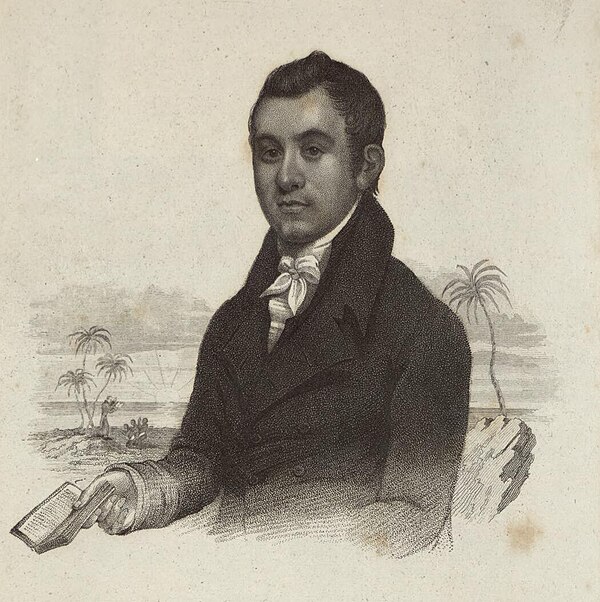
William Milne (Chinese name Mi Lian, 米怜; April 27, 1785 – June 2, 1822), a Scot, was the second Protestant missionary to come to China after Robert Morrison (马礼逊). Both belonged to the London Missionary Society.
Life
Milne was born in 1785 in the parish of Kennethmont near Huntly, Aberdeenshire, Scotland. As a boy he was apprenticed to a carpenter. He joined the church in 1804 and the London Missionary Society in 1809. Milne came to China in 1813 (the 18th year of Jiaqing). At first the mission society did not consider him qualified to be a missionary to China. They felt that missionaries sent to a place of such deep culture as China had to be, like Matteo Ricci and Robert Morrison, highly educated and trained in medicine and astronomy. But Milne’s father had died when he was six, and as a child he had been a shepherd boy; he was rough in manner, and his education and learning were very limited. So they thought that sending someone like Milne would be like damaging God’s honour. One member of their selection committee even said, “You would be best suited to be a labourer.” But Milne truly had a calling to mission in China, and in the end the society allowed him to go. At the time he said, “If you think I am not qualified, then I can do any work in China.” He said, “I will wash clothes and cook, I will serve Dr. Morrison so that he can devote himself to preaching; I am willing to do any servant’s work.”
After coming to China, Milne could not, like Morrison, reside legally in Canton as a translator for the East India Company. So Milne lived in Malacca, on the west of Malaysia. There were many overseas Chinese there, and the facilities were very good. His wife came with him to Macau, and he went alone to Malacca to work and serve. His main role was to assist Morrison: in Malacca he founded the Anglo-Chinese College and became its first principal; he also published the magazine Cha Shisu Meiyue Tongji Zhuan (Chinese Monthly Magazine) and printed and published books — chiefly as an assistant. But after several years of earnest service and study, Milne’s Chinese became very good, so that by the time of his death many people called him “Dr. Milne.” In 1819 Milne published in Malacca Zhang Yuan Liang You Xiang Lun (Dialogues between Two Friends, Zhang and Yuan), a Chinese vernacular novel in chapters drawing on Bible stories; it was later reprinted as many as 30 times in Malacca, Singapore, Shanghai, Ningbo, Hong Kong, Fuzhou, Hankou, and elsewhere, and circulated widely. In 1817 (the 22nd year of Jiaqing) he left Malacca and reached China in early September. In 1818 (the 23rd year of Jiaqing) he returned to Malacca. On 20 March 1819 (the 24th year of Jiaqing) his wife, Rachel Cowie Milne, died of illness in Malacca. In 1820 the University of Glasgow awarded him an honorary Doctor of Divinity. He died on June 2, 1822.
Milne and his wife both died in Malacca. Mrs. Milne’s grave is still in an old cemetery in Malacca, with a headstone bearing her name; as for Milne’s body, it is generally believed to be buried beneath Christ Church Melaka.
Works
- Jiushizhe Yanxing Zhen Shiji [A True Record of the Words and Deeds of the Saviour], 1814, Canton.
- Jin Xiao Men Zou Zhai Lu Jielun [Explanation of Entering the Small Gate and Walking the Narrow Way], 1816, Malacca.
- Chong Zhenshi Qi Jiahuang Lüeshuo [Brief Discourse on Honouring Truth and Rejecting Falsehood], 1816, Malacca.
- Youxue Qianjie Wenda [Simple Questions and Answers for Children], 1817, Malacca.
- Qidao Zhenfa Zhujie [Commentary on the True Method of Prayer], 1818, Malacca.
- Zhuguo Yishen Lun [On the Strange Gods of the Nations], 1818, Malacca.
- Shengyi Gongping Juyi Fa [Fair Dealing in Trade as the Way to Profit], 1818, Malacca.
- Shengshu Jiezhu Shi’er Xun [Twelve Lessons with Notes on Scripture Passages], 1818, Malacca.
- Dubo Minglun Lüejiang [Brief Discourse on Gambling], 1819, Malacca.
- Zhang Yuan Liang You Xiang Lun [Dialogues between Two Friends, Zhang and Yuan], 1819, Malacca.
- Gujin Sheng Shiji Ji [Collected Sacred History, Ancient and Modern], 1819, Malacca.
- Shouzai Xueyi Lunshuo [On Learning Righteousness through Calamity], 1819, Malacca.
- Sanbao Renhui Lun [On the Three Treasures and the Benevolent Society], 1821, Malacca.
- Quandi Wanguo Jilüe [Brief Account of All the Nations of the Earth], 1822, Malacca.
- Xiangxun Wushi’er Ze [52 Village Lessons], 1824 (posthumous), Malacca.
- Shangdi Sheng Gonghui Men [The Door of God’s Holy Church], 1824, Malacca.
- Linghun Pian Daquan [Complete Treatise on the Soul], 1824, Malacca.
- Shentian Shengshu [The Holy Scriptures] (translated jointly with Robert Morrison), 1823–1824, Malacca (posthumous).
- Shengshu Jiejie [Explanations of Scripture Passages], 1825 (posthumous), Malacca.
- Cha Shisu Meiyue Tongji Zhuan (Chinese Monthly Magazine), 1815-1821, Malacca.
📚 Major Works


🎬 Videos
Visiting the Footsteps of William and Rachel Milne in Malacca
Videos are hosted on YouTube and uploaded by their original producers. YouTube loads only when you press play and may be unavailable in some regions.