💬 Famous Quotes
📋 Basic Information
📖 Biography
The Baker's Son
Otto F. Schoerner (石爱乐) was born on 20 August 1906 in Union City, Pennsylvania, USA. His parents were German immigrants who ran a bakery in Butler, Pennsylvania, in the 1920s. As a boy he joined the youth group of St. Mark's Lutheran Church and, under the guidance of a devout Christian, Mr. Tao Man (陶镘), studied the Bible and received the Lord Jesus. At 16 he began learning the baker's trade in the shop under his father, and soon afterward his father was killed in a car accident; after that he and his family kept running the bakery to make a living. Mr. Tao Man became his spiritual father: besides teaching him in Sunday school, he guided him in reading Bible commentaries and missionary biographies. Mrs. Tao Man had graduated from Moody Bible Institute, and the couple held a Bible study class in their home. Over several years Schoerner completed the entire Scofield Bible correspondence course.
Three Things
In 1927 he left the bakery in the care of his mother and younger brother and entered Moody Bible Institute to study in its missionary medical course, also taking Greek and music; he graduated in April 1931. Three things shaped him during his studies. In 1929 the China Inland Mission appealed for 200 missionaries for China, and he gladly took up the challenge. He read Borden of Yale and was deeply moved, resolving to take the gospel to Muslims in Northwest China. And on campus a couple, Mr. and Mrs. Pei Zhongqian (裴忠谦), who had been missionaries in China, held a prayer meeting in their home every week; many who attended later went to China as missionaries, and it was at this prayer meeting that he met Miss Dao Qingjie (道清洁).
The Baker Who Drove a Truck into Xinjiang
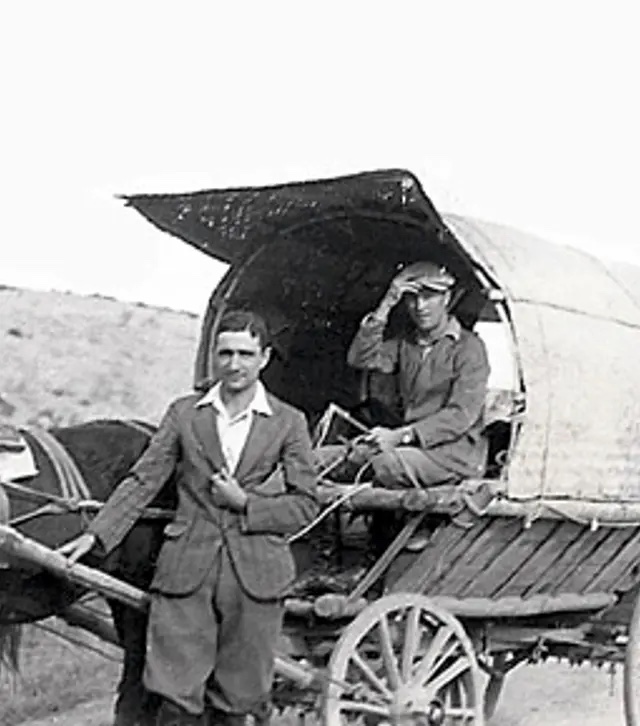
On 1 October 1931 he set out from Vancouver for China and arrived in Shanghai on 22 October. He went straight to Anqing for language study, and after about six months passed the first-grade Chinese examination. He was then assigned, together with Dr. Ba Fuxi (巴富羲), Zhao Lide (赵立德), He Renzhi (何仁志), Zhu Peiru (朱佩儒) and Bo Aisheng (柏爱生), six in all, to Dihua (now Urumqi) in Xinjiang. Because fighting had cut off the roads, they finally decided to drive themselves: Ba Fuxi and others bought two Ford trucks in Tianjin, and on 13 September 1932 they set out from Zhangjiakou, passing through the Great Wall into Inner Mongolia. Each had his task on the road; Schoerner, the former baker, was in charge of meals on the way. After reaching Xinjiang he preached and gave medical care among Kazakh, Uyghur and Mongol herders around Qitai, and after passing the sixth-grade Chinese examination began learning the local minority languages. After several years of labor they had built up a small group of believers there; a co-worker, Mr. Wen, had preached in the open air with them, and at Christmas more than ten believers gathered and gave testimony.
Over the Roof of the World
After the Marco Polo Bridge Incident of 7 July 1937 the situation in Xinjiang grew tense and their movements began to be restricted; going in or out of Qitai County required police permission. In April 1938 a telegram came from the mission headquarters in Shanghai telling them to withdraw to the coast before autumn. But just as they were preparing to set out, the political situation grew worse and all roads east were closed, so they had to go west and make a detour through India. They left Dihua on 18 June and, in the heat, traveled west along the old Tianshan road for 40 days, about 1,000 miles, to Kashgar, then waited another 20 days to join three Swedish missionaries. The party of six, with a caravan of more than 30 horses and an escort of three soldiers, went south toward India in mid-August. He never forgot that journey: they traveled on the "roof of the world" where China, Russia, Afghanistan and India meet, crossing one snow mountain after another among the high peaks of the Himalayas, and only at the end of September did they enter Hunza, then part of British India (now in Pakistan). Standing on an ice-covered summit, the six sang the Doxology together in thanks for their escape. They went on south to Calcutta (now Kolkata), took ship, and traveled by way of Malaysia, Singapore and Hong Kong to Shanghai, arriving on 20 November, six months in all.
Six Months to Marry His Bride
He and Dao Qingjie had corresponded for six years, and their feelings had long since matured. After he reached Shanghai the two decided to marry, and an English-language newspaper in Shanghai ran the news under the headline "Young Man Travels Six Months to Marry His Bride". They were married on 25 November, with her father, Dr. Dao Yabo (道雅伯), officiating, and honeymooned in Qingdao, Shandong; Dao Qingjie had been born in Qingdao in 1908 to Presbyterian missionary parents. Afterward, during the war against Japan, they moved from place to place escorting newly arrived missionaries: riding a bicycle alongside 13 rickshaws loaded with baggage, alternating between water and land routes, they met danger after danger amid war and chaos. In early 1943 the Japanese army made a surprise attack and occupied Huangchuan; pushing his bicycle, with his wife holding their young son on a wheelbarrow, he fled north and finally reached eastern Henan. Just then the principal of the Henan Bible Institute was being transferred, and he was appointed principal of the institute, so the family moved to Zhoujiakou (now Zhoukou). He later also became superintendent of the Borden Memorial Hospital in Lanzhou. He died in 2008, at more than a hundred years of age.