💬 Famous Quotes
📋 Basic Information
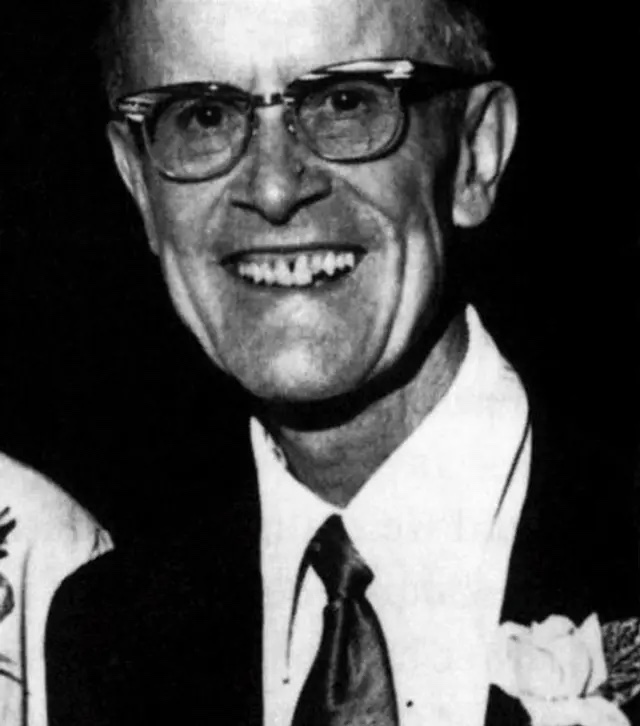
📖 Biography
A Person Who Read the Bible and Prayed but Did Not Believe
James Hudson Taylor II (戴永冕) was born in Scotland on 24 February 1894, the elder of twin brother and sister; at six months old he sailed with his parents to China. As a boy he attended the Chefoo School, founded by his grandfather and where his father taught. Although he grew up in a Christian family, he was known for his mischief and often gave his parents and teachers headaches. He later said of himself that he was very proud at that time; though the family read the Bible and prayed, he himself was "a person who read the Bible and prayed but did not believe." Then one day, moved by the Holy Spirit, he accepted the Lord Jesus, and wept bitterly as he confessed his sins and repented. This prodigal's return later became a powerful testimony that helped many people come to faith.
Pharmacist and Free Methodist
After graduating from high school he went to Shanghai to study medicine and pharmacy. He completed his studies in 1917 and was assigned as a pharmacist to the Gospel Hospital run by the China Inland Mission in Kaifeng, Henan. Because he often experienced weakness and failure in daily life, he felt that a Christian ought to overcome through the Lord, and so he frequently fasted and prayed and practiced a holy life. When his work in Kaifeng came to an end, he went to the United States to study at George Washington University and received a Bachelor of Arts degree. In 1924 he married Alice (Alice E. Hayes, Chinese name 戴永和). The Taylor family had been British, but from his generation they became American citizens. In the United States he joined the Free Methodist Church, and after graduating he and his wife pastored for more than two years. In 1926 he was ordained, and sent by the Free Methodist mission, he returned to China with his wife, back to Kaifeng.
Three Phrases of Japanese
In 1927 he founded the Kaifeng Bible School and became its principal, devoting himself to theological education. His four children, Ailian, Shaozeng, Aimei and Shaoren (爱莲、绍曾、爱美、绍仁), were all born in Kaifeng. After the Sino-Japanese War broke out, Kaifeng fell to Japanese forces in June 1938. At the time more than a thousand Chinese women and children had hidden in the Kaifeng Bible School, and a squad of Japanese soldiers came to the school gate demanding to enter and search; the situation was extremely dangerous. Years later Rev. James Hudson Taylor III (戴绍曾) recalled that his father stood alone at the gate and said to the Japanese in English, "I'm sorry, I only know three phrases of Japanese." Then he said the three phrases in Japanese: "Hello, thank you, goodbye." The Japanese officer leading the squad, on hearing this, actually smiled, and turned and left with his soldiers. More than a thousand women and children were saved as a result.
Cradle of the Preach the Gospel Everywhere Band
When the war situation grew tense he at one point intended to leave China, but in the end he stayed and moved to the northwest. The Northwest Bible Institute, which he later led, left a distinctive mark in the history of the Chinese church: under his long-term influence and support, the whole faculty and student body held a strong sense of mission toward world evangelization. On the evening of 25 November 1942, the vice-principal, Rev. Ma Ke (马可), received a vision of carrying the gospel to the northwest; at dawn on Easter the following year, many teachers and students prayed together for this. On 23 May 1943 the "Chinese Christian Preach the Gospel Everywhere Band" was formally founded, its name taken from Matthew 24:14; in the West it is called the "Back to Jerusalem" mission. After this, Zhao Maijia (赵麦加), Dai Yanzhong (戴彦中), He Enzheng (何恩证) and others set out one after another from here, through Lanzhou, Xining and the Hexi Corridor straight into Xinjiang. Zhao Maijia, who is included in this database, was the first Han Chinese missionary to go deep into southern Xinjiang from this school.
Holy Light in Kaohsiung
After 1949 Western missionaries withdrew one after another. In 1953 James Hudson Taylor II moved with his family to Taiwan, the first generation of the Taylor family to shift from the mainland to Taiwan; that year was exactly one hundred years after Hudson Taylor set out for China. In September 1955, at the age of sixty-one, he founded Holy Light Bible College in Kaohsiung and became its president. This was the third time, after Kaifeng and the northwest, that he had established theological education for the Chinese church; in 1967 the college was upgraded to a seminary. He regarded his students as his own children. The college was close to Kaohsiung railway station, and sometimes, despite his age, he went to the station himself to meet students and insisted on carrying their luggage. Besides the college's affairs, he and his wife pioneered evangelism in the plains and mountain areas of the Kaohsiung–Pingtung region and took part in founding dozens of churches. All his life he loved the souls of the Chinese people, and in his later years he repeatedly asked the American mission to let him stay in China for life; only because brothers and sisters in the American church were concerned for his health did they earnestly ask him to return to the United States to spend his remaining years in peace. In the summer of 1967, at the age of seventy-three, he formally retired and left China. He spent his last ten years in the United States, still preaching and writing, and died on 11 May 1978, aged eighty-four.