💬 Famous Quotes
📋 Basic Information
📖 Biography
From Bookkeeper to Missionary
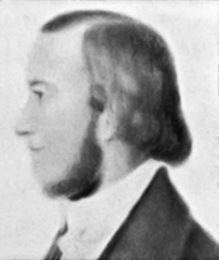
Theodore Hamberg (韩山明; original name Knut Theodor Hamberg, also written in Chinese as 韩山文) was born in Sweden on 25 March 1819. His father was a ship's captain, who died in 1830 when Hamberg was only eleven. As a youth he worked at the British consulate and was close to the consul's family; the consul's daughter, the writer Mathilda Foy, later often wrote about him in her articles. After finishing school he worked as a bookkeeper for a trading house in Stockholm. In 1842 he was converted under the preaching of the pietist revival preacher Carl Olof Rosenius, and the two became close friends. In 1844 he gave up bookkeeping and joined the Basel Mission, and spent the next two years training at its mission school in Switzerland.
The First Western Description of Hakka
In 1846 he was sent to China, arriving on 19 March the following year, and took up mission work in Guangdong, bringing the gospel to the Hakka community. He did something quite pioneering for the time: he wrote the first Western description of the Hakka dialect. This draft later became the basis for the Hakka dictionary compiled by D. MacIver; Western systematic study of the Hakka dialect can be said to have started with him.
Disagreement with Gützlaff
At first he worked under the influential German missionary Karl Gützlaff (郭实猎), but he gradually came to doubt Gützlaff's strategy. Gützlaff advocated large-scale, rapid conversion, while Hamberg believed a more careful approach was needed: conversion requires real teaching and time. This disagreement brought him into conflict with Gützlaff and also with the Basel Mission itself. After Gützlaff's death, events proved Hamberg's judgment right, and he was able to continue serving in the Basel Mission.
Hong Rengan's Account
In 1852 an unexpected event placed him at the scene of history. He met Hong Rengan (洪仁玕), a younger clan cousin of Hong Xiuquan (洪秀全), who had become separated from the Taiping army and had fled to Hong Kong. Hamberg taught him the Christian faith and baptized him. Hong Rengan also told him the story of how the Taiping rising began and of Hong Xiuquan's early life. On this basis Hamberg wrote a book, the first work in a Western language to give a detailed account of the Taiping Heavenly Kingdom, and it remains an important historical source for the study of Hong Xiuquan's early life.
Thirty-Five Years
On 13 May 1854 Theodore Hamberg died of dysentery in Hong Kong, only thirty-five years old. He spent just seven years in China, yet he left three things behind: the starting point of Hakka dialect studies, a first-hand account of the Taiping Heavenly Kingdom, and the foundation of the Basel Mission's work among the Hakka of Guangdong, a line later carried on by Rudolf Lechler (黎力基) and others.