💬 Famous Quotes
📋 Basic Information
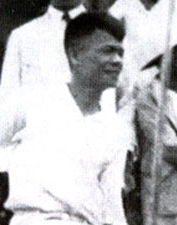
📖 Biography
Early Years
John Sung was born on 27 September 1901 in Fengji Village, Xinghua (now Putian), Fujian. It was the day of the Mid-Autumn Festival, and his childhood name was Tian'en. His father, Song Xuelian (宋学连), was a pastor who later became vice-principal of the Xinghua Gospel Academy (兴化福音书院). In 1909, when he was nine, the great revival meetings of the Xinghua church made a deep impression on him. As a boy he helped his father edit a revival paper outside school hours, and people called him “the little pastor.” In 1919 he graduated first in his class from Zheli Middle School (哲理中学).
Study in the United States
In the spring of 1920 he obtained a tuition-free place at Ohio Wesleyan University in Delaware, Ohio; his travel money was raised and lent by his father's students. After enrolling he set aside his original plan to study theology and took up chemistry instead, completing four years of coursework in three, and graduated with the highest honours in 1923. He then went on to Ohio State University, receiving a master's degree in 1924 and a PhD in chemistry on 19 March 1926; during his doctoral studies the government in China granted him an official stipend because of his outstanding record. That same year Peking Union Medical College in Peiping (Beijing) invited him back to teach at an annual salary of 1,800 yuan, but he declined.
New York: 193 Days in a Mental Hospital
In the autumn of 1926 he entered Union Theological Seminary in New York, but felt that it had “only the signboard of theology and no spiritual atmosphere.” In February 1927, in tearful prayer, he experienced the new birth. Soon afterwards the seminary had him sent to a mental hospital, where he stayed from 17 February to 30 August, 193 days in all. There he read the Bible through forty times, using forty different methods. He later said, “The mental hospital was a special seminary God prepared for me.”
Returning Home: Casting Away the Gold Key
In October 1927 he sailed home from Seattle. He later recalled in a sermon that on board he saw fellow Chinese smoking opium and gambling, and heard a foreigner say something insulting about the Chinese. He went back to his cabin and prayed in tears: “I threw the gold key of my doctorate into the sea; I resolved that, even unto death, I would preach in China.” In November he returned to Xinghua, and in December he married Yu Jinhua (余锦华).
Three Years in Fujian (1927–1930)
After his return he taught chemistry and Bible at the Zheli Boys' School and the Xianyi Girls' School (咸益女校) in Xinghua, earning 24 yuan a month. Outside class he took students into the countryside to preach, and led meetings in Zhangzhou, Xiamen and Quanzhou in southern Fujian and in many places in northern Fujian, running a “travelling theological school.” In 1930 he divided the more than 100 churches of the Xinghua area into a dozen or so training districts; that year more than 1,000 households held family worship.
The Bethel Worldwide Evangelistic Band (1931–1933)
In early 1931 the Rev. Andrew Gih invited him to Bethel, and together with Andrew Gih, Lin Jingkang (林景康), Li Daorong (李道荣) and Nie Ziying (聂子英) he formed a travelling evangelistic band. That same year, in Nanchang, he came to understand three things that revive a church: earnest prayer in one accord, thorough confession of sin, and seeking to be filled with the Holy Spirit. Over the next three years the band travelled throughout the Northeast, Shandong, South China, North China, Henan and Shanxi. In June 1933 Andrew Gih summed up the work in several provinces of North China: revival meetings in 19 places, more than 7,000 people who received grace, 457 evangelistic bands formed, and more than 1,200 people who dedicated themselves to preaching. At the end of 1933 he left Bethel.
Independent Preaching by Faith (1934–1940)
From 1934 he “preached freely by faith, with God as his backing,” without a fixed salary. He was often away 11 months of the year, leading meetings three times a day and sometimes four. His preaching was direct, stressing confession and repentance, the new birth and the filling of the Holy Spirit; after the meetings he often organized the believers who had received grace into evangelistic teams.
Southeast Asia and Taiwan
From 1935 to the end of 1939 he went south again and again. His diaries and reviews of his work record the figures of the time, place by place:
- May–June 1935, the Philippines: at the meetings in Manila, 657 people received grace.
- August–October 1935, first visit to Nanyang (Southeast Asia): in Singapore 1,363 people repented and seventy or eighty dedicated themselves to preaching; he also went to Malacca, Penang (564 received grace, 33 dedicated themselves), Sitiawan and Medan in Sumatra. In October he returned to Singapore to hold spiritual-life meetings attended by about 2,000 people; an evangelistic band was formed, with Wu Jingling (吴静聆) as its general leader. A local English-language newspaper called him “the John Wesley of China.”
- April–May 1936, Taiwan: 25 days in Taipei, Taichung and Tainan, with seven to eight thousand people receiving grace; in Tainan alone 4,063, and 244 evangelistic teams were formed.
- September–December 1936, second visit to Nanyang: Singapore, Sibu (“New Foochow”; more than 1,500 repented), Sarikei, Muar, Kuala Lumpur, Klang and Penang, and as far as Rangoon (now Yangon) in Burma, returning to Singapore at the end of the year.
- May 1938, Annam (Vietnam): Haiphong, Hanoi, Vinh Long, Saigon-Cholon and Da Nang.
- September 1938 to January 1939, Siam and Malaya: Bangkok and other places; then Singapore, Batu Pahat, Seremban, Penang, Taiping, Sitiawan, Ipoh, Segamat and Kuala Lumpur.
- January–March 1939, the Dutch East Indies (now Indonesia): he flew for the first time, to Surabaya (652 received grace), and went on to Magelang, Solo, Bandung and Batavia (now Jakarta); in Batavia more than 800 people repented, among them two or three hundred Dutch people.
- May–August 1939, second visit to Siam: from Chiang Mai in the far north to the far south, eleven places in a little over two months; more than 3,000 people received grace, and 285 evangelistic teams and an all-Siam general evangelistic band were formed.
- August–November 1939, second visit to the Dutch East Indies: Bogor, Cirebon, Semarang (1,239 people), Yogyakarta, Pekalongan, Surabaya, Makassar and Ambon.
- End of 1939: on the way back through Singapore and Malaya, he fell ill in Penang and preached lying on a bed placed on the platform. In January 1940 he returned to Shanghai.
Illness and Rest (1940–1944)
He had suffered from haemorrhoids since 1921 and preached for many years while ill. From 1940 his illness grew serious; he underwent several operations in Shanghai, Peiping and Tianjin, and in 1941 moved to Xiangshan (the Fragrant Hills) in the western suburbs of Peiping to recuperate. In the same year his young son Tianzhi died. On 17 August 1944 he said to those around him, “Pray much; the work from now on is the work of prayer.” Early on the morning of 18 August he went to his rest at his home in Xiangshan, only forty-two years old. The encoffining service was led by Wang Mingdao (王明道).
Family
His wife, Yu Jinhua, was engaged to him in 1922, married him in 1927, and died in 1980. The book records his eldest daughter Tianying (天婴, born 1929), a daughter named Liweiji (利未记, “Leviticus,” born 1932), and others; two sons, both named Tianzhi, died in early childhood. The back of his gravestone bears the names of Mrs. Sung and three daughters.
📚 Major Works
📚 References & Sources
- Ling Li Ji Guang (灵历集光) [Spiritual Diary], compiled by "Levi" (includes John Sung's diaries, letters and the dictated accounts My Testimony and Looking Back on the Work), Project Gutenberg eBook #25716