Not sure where to start?
Try our reading paths — books in order, with a guide for each step(5)→




Chinese edition of Encountering the Old Testament (Bill T. Arnold and Bryan E. Beyer) and Encountering the New Testament (Walter A. Elwell and Robert W. Yarbrough). Rich in background, it provides the sources, historical and geographical overview and principles of interpretation for the whole Bible, with an introduction to each of its major sections so that readers can readily grasp its structure and distinctive features. Each chapter offers an outline and summary, highlights key terms, and ends with study questions, notes and a bibliography for those who want to go deeper. Written from an evangelical standpoint as a textbook for seminary students, it is also a valuable reference for lay people who want to study the Bible seriously.
By Tremper Longman III and Raymond B. Dillard (revised edition). A solid and accessible introduction that prepares readers to bridge the gap between the modern world and the ancient setting of the Old Testament, to appreciate its literary beauty, and to recognise the abundant presence of God. It gives a basic grasp of each book of the Old Testament along with guidance for further reading, and is a foundational textbook widely used by seminary teachers.
The Institutes of the Christian Religion is John Calvin's systematic exposition of Protestant theology. It has had an enormous influence on the Western world and is required reading for students of theology in many parts of the world. First published in Latin in 1536, it appeared in Calvin's native French in 1541 and reached its final form in the Latin edition of 1559 and the French edition of 1560; the final Latin edition runs to eighty chapters.
The Westminster Confession of Faith is a classic statement of Christian theology. It was drafted over some three years of debate by more than a hundred ministers and theologians of the Westminster Assembly in England, and completed in December 1646. It remains one of the most influential confessions of the Reformed and Presbyterian churches, widely admired for its clarity, depth, precision and comprehensiveness.
This volume collects Augustine's key writings on human nature. On Free Choice of the Will explores the origin of evil and the question of human free will; On Nature and Grace sets out humanity's total corruption and God's total grace. Together the two works lay the foundations of Augustine's thinking about human nature.
As a young British missionary, James O. Fraser went alone into the borderlands of Yunnan. He planted churches, devised a written script for the Lisu language, translated the Bible and recorded the history of the Lisu people, giving his whole life for them. Written by his daughter Eileen Crossman, Mountain Rain draws on the diaries and letters of Fraser's thirty years of missionary service, giving a true picture of the fierce spiritual battles he faced and the renewal and breakthroughs that came amid pressures from without and within.
Mere Christianity grew out of the radio talks C.S. Lewis was invited to give on the BBC during the Second World War, presenting the faith held in common by Christians across the denominations. Lewis sets out the heart of that faith with warmth and clarity. It is widely regarded as his most popular book and one of the most important religious works of the twentieth century.
The Canons of Dort, formally "The Decision of the Synod of Dort on the Five Main Points of Doctrine in Dispute in the Netherlands" and also known as the Five Articles against the Remonstrants, set out the doctrine adopted by the Synod of Dort in 1618–1619. Although it was a national synod of the Dutch Reformed Church, the gathering was genuinely international: sixty-two delegates from across the Netherlands were joined by twenty-seven delegates from eight other countries.
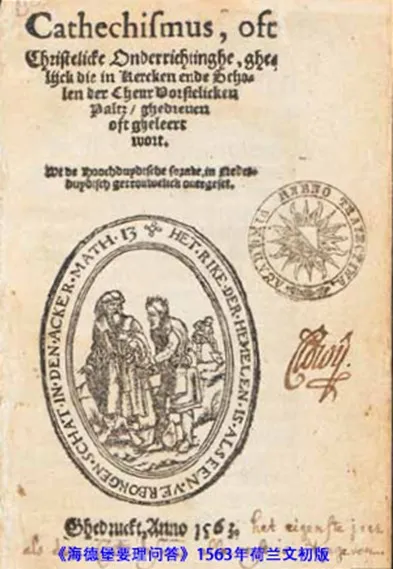
The Heidelberg Catechism was written in Heidelberg in 1563 at the request of Elector Frederick III (r. 1559–1576), ruler of the Palatinate, the most influential German territory of its day. This devout prince commissioned Zacharias Ursinus, then just 28 and professor of theology at the University of Heidelberg, and Caspar Olevianus, his 26-year-old court preacher, to prepare a catechism for instructing the young and for guiding pastors and teachers. The whole theological faculty was consulted in its preparation, and it was adopted by a synod in Heidelberg the same year.
The Belgic Confession, the confession of faith of the Dutch Reformed churches, was written in 1561 and is sometimes called the Walloon Confession. Its author, Guido de Brès, wrote it in defence of the persecuted Reformed churches of the Low Countries. It was translated from French into Dutch in 1562, approved by a synod at Antwerp in 1566, and adopted by the Synod of Dort in 1618–1619. Together with the Heidelberg Catechism and the Canons of Dort it forms the doctrinal basis of the Dutch Reformed tradition, and it is still a confessional standard for Reformed churches in North America today.
The Westminster Shorter Catechism was produced by the Westminster Assembly in England in 1647. It serves both as a guide for teaching children and new believers and as one of the best introductions to theology for any Christian. Arranged according to the inner logic of Christian doctrine, it is one of the doctrinal standards of the Reformed churches.
Baxter's charge to ministers (1656) on Acts 20:28: first guard your own soul, then the flock — above all through personal, household-by-household catechising, as he practised in Kidderminster. "Reformed" means renewed, not a denomination.