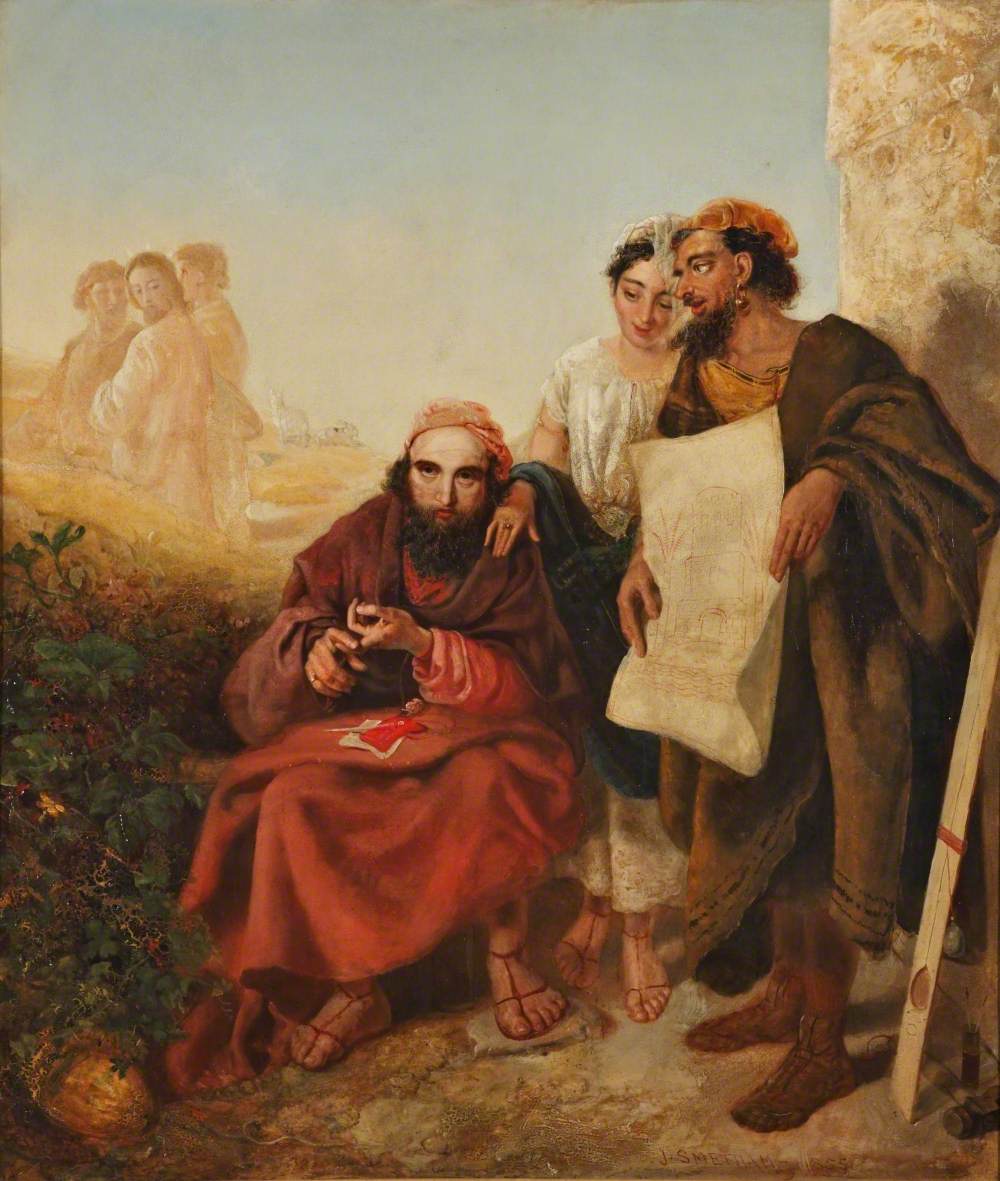
一个披着红袍的人坐在石头边,低着头,用一只手掰着另一只手的手指,膝上放着一张红色的纸。一个年轻女子站在他身后,一只手搭在他肩上。旁边一个缠头巾的人,捧着一大张纸,上面画着一座有拱门的房子,他用手指点着图。右边靠着一根木杆。左上方远处,三个人影淡淡地走过,中间那一位回过头来。你看,坐着的人在算什么?
詹姆斯·斯梅瑟姆(James Smetham),《算计花费》(Counting the Cost),1855 年,油画,英国利物浦沃克美术馆藏。公有领域。 Wikimedia Commons一起读路 14:28-33
(25–27 节)有极多的人和耶稣同行,他转过来对他们说话(见“当时现场”)。
28“你们哪一个要盖一座楼,不先坐下算计花费,能盖成不能呢?
29恐怕安了地基,不能成功,看见的人都笑话他,
30说:‘这个人开了工,却不能完工。’
31或是一个王出去和别的王打仗,岂不先坐下酌量,能用一万兵去敌那领二万兵来攻打他的吗?
32若是不能,就趁敌人还远的时候,派使者去求和息的条款。
33这样,你们无论什么人,若不撇下一切所有的,就不能作我的门徒。”
当时现场
一大群人跟着走。 「有极多的人和耶稣同行,他转过来对他们说」(路 14:25)。前面,他在一个法利赛人首领家里吃饭,讲了大筵席的比喻(14:1-24)。马亨利说,对法利赛人,他讲的是谦卑和爱;这里,他转过来对着跟在后面的群众,要他们在承认作门徒以前,先明白作门徒的条件。
Matthew Henry, Commentary on the Whole Bible, Vol. V,路 14:25-35。译自英文原著。
看英文原文
To Pharisees he preached humility and charity. He is in these verses directing his discourse to the multitudes that crowded after him, and seemed zealous in following him; and his exhortation to them is to understand the terms of discipleship, before they undertook the profession of it, and to consider what they did.
他们指望什么。 吉尔说,那时许多人跟着,“或许都在指望他到了耶路撒冷,就建立地上的国度”。
John Gill, Exposition of the Entire Bible,路 14:25。译自英文原著。
看英文原文
and all perhaps were in expectation of his setting up a temporal kingdom when he came there
他先说了两句重话。 「人到我这里来,若不爱我胜过爱自己的父母、妻子、儿女、弟兄、姐妹和自己的性命,就不能作我的门徒。凡不背着自己十字架跟从我的,也不能作我的门徒」(路 14:26-27)。马太福音也记了相近的话(太 10:37-38)。
26 节和合本译作“爱我胜过”,原文是“恨”。克拉克说,这是希伯来的说法:雅各「爱拉结胜似爱利亚」(创 29:30),下一节就说「利亚失宠」(创 29:31),原文也是“恨”,意思是爱得少。马亨利说,这“不是对他们本人有一点恨”。
Adam Clarke, Commentary on the Bible,路 14:26;Matthew Henry, Commentary on the Whole Bible, Vol. V,路 14:25-35。译自英文原著。
看英文原文
where Leah's being hated is explained by Rachel's being loved more than Leah
Not that their persons must be in any degree hated, but our comfort and satisfaction in them must be lost and swallowed up in our love to Christ
什么样的楼。 克拉克说,这“楼”大概就是一座住房,照东方的样式,房顶上砌了垛墙,可以乘凉,也可以躲避、防守。
Adam Clarke, Commentary on the Bible,路 14:28。译自英文原著。
看英文原文
Probably this means no more than a dwelling house, on the top of which, according to the Asiatic manner, battlements were built, both to take the fresh air on, and to serve for refuge from and defense against an enemy.
后面接着讲盐。 两个比方讲完,耶稣说:「盐本是好的,盐若失了味,可用什么叫它再咸呢?」(路 14:34)
讲解
看见什么。 两个问句,都是“你们哪一个……”,问的是听的人自己会怎么做。两个人都做同一件事:“先坐下”。盖楼的「先坐下算计花费」(28 节),打仗的王「先坐下酌量」(31 节)。
马亨利说,两个比方各有重点:“前一个说,我们要估量信仰的花费;后一个说,我们要估量信仰的危险。”
Matthew Henry, Commentary on the Whole Bible, Vol. V,路 14:25-35。译自英文原著。
看英文原文
the former showing that we must consider the expenses of our religion, the latter that we must consider the perils of it.
没算好的结局,是被人笑话:「这个人开了工,却不能完工」(30 节)。
如果我在场。 我在那一大群人里。马亨利说,大家以为他会说:“凡到我这里来作我门徒的,必得着丰富的钱财和尊荣。”“他却告诉他们正相反的话。”
Matthew Henry, Commentary on the Whole Bible, Vol. V,路 14:25-35。译自英文原著。
看英文原文
They expected that he should say, "If any man come to me, and be my disciple, he shall have wealth and honour in abundance; let me alone to make him a great man." But he tells them quite the contrary.
马亨利还说,撒但“只给人看好的,把坏的藏起来”;基督却经得起人仔细查看。
Matthew Henry, Commentary on the Whole Bible, Vol. V,路 14:25-35。译自英文原著。
看英文原文
Satan shows the best, but hides the worst, because his best will not counter-vail his worst; but Christ's will abundantly.
神是怎样的神。 耶稣没有先让人跟上来,再慢慢说难处。他在路上转过身来,当着一大群人把代价说在前头。马亨利说:“他既然这样公道,把跟从他要遇见的难处明明告诉我们,我们也要对自己公道,认真掂量。”
Matthew Henry, Commentary on the Whole Bible, Vol. V,路 14:25-35。译自英文原著。
看英文原文
Since he has been so just to us as to tell us plainly what difficulties we shall meet with in following him, let us be so just to ourselves as to weigh the matter seriously before we take upon us a profession of religion.
可是“算计花费”,不是叫人算出自己够不够。马亨利说:“真的,我们谁也没有足够的力量自己盖成这座楼;但基督说过:我的恩典够你用的。”「我的恩典够你用的」(林后 12:9)。保罗也说:「我深信那在你们心里动了善工的,必成全这工」(腓 1:6)。
Matthew Henry, Commentary on the Whole Bible, Vol. V,路 14:25-35。译自英文原著。
看英文原文
It is true, we have none of us in ourselves sufficient to finish this tower, but Christ hath said, My grace is sufficient for thee
和我有什么关系。 马亨利列了这座楼可能要付的价:治死自己的罪,连最爱的私欲也在内;一生舍己、警醒;也许还有名声、产业、自由,甚至性命。接着他问:“就算要付上这一切,比起基督为我们买来这些所付的代价,又算什么呢?”
Matthew Henry, Commentary on the Whole Bible, Vol. V,路 14:25-35。译自英文原著。
看英文原文
And if it should cost us all this, what is it in comparison with what it cost Christ to purchase the advantages of religion for us, which come to us without money and without price?
吉尔提醒,“先坐下”不是叫人一直坐着:这“不是说该承认信仰的人要拖延”,而是要想清楚、小心、谨慎地去做。
John Gill, Exposition of the Entire Bible,路 14:28。译自英文原著。
看英文原文
which does not imply, that persons should delay making a profession, on whom it is incumbent; but that this should be done with thoughtfulness, care, and prudence
不同的看见
下面三位都是英国的解经家:马亨利(1662–1714)、吉尔(1697–1771)、克拉克(约 1760–1832)。各段都译自英文原著,出处附在后面。
经文自己说的(三家都照这个讲): 盖楼的、打仗的,都要先坐下算一算;算的是自己能不能做到底。耶稣把这两个比方落在 33 节:撇下一切所有的,才能作他的门徒。下面两处,是读法不同的地方。
一、那个“领二万兵来攻打”的王,是谁?
这一处有一部分是寓意读法:把比喻里的人物各对应一位。比喻本身只说:兵力不够,就趁早求和。
他的主要读法是:作门徒的要估量跟从基督的危险,看自己能不能抵挡“地狱和世界的势力,带着两万兵来攻”。他又说,这比喻“另有一种用法”:一直犯罪的人是在和神打仗,最骄傲的罪人也不是神的对手,所以要趁早和神和好,同「你同告你的对头还在路上,就赶紧与他和息」(太 5:25)是一个意思。
Matthew Henry, Commentary on the Whole Bible, Vol. V,路 14:25-35。译自英文原著。
看英文原文
whether we are able to encounter the forces of hell and earth, which come against us twenty thousand strong.
This parable is another way applicable
Those that persist in sin make war against God
一方的王是承认基督的人,“另一方的王是魔鬼”。所以他说,派人去求和,就是“放弃和罪、撒但、世界争战,和它们讲和”,那是“羞耻、可耻的”。
John Gill, Exposition of the Entire Bible,路 14:31-32。译自英文原著。
看英文原文
The king on the other side, is the devil
so to give out, and leave off fighting with sin, Satan, and the world, and make peace with them, is shameful and scandalous
31、32 两节没有另加解释。他在 28 节说,这个比喻显明,没有想过要遇见什么难处、自己有什么力量,就去作门徒,是荒唐的。
Adam Clarke, Commentary on the Bible,路 14:28。译自英文原著。
看英文原文
This parable represents the absurdity of those who undertook to be disciples of Christ, without considering what difficulties they were to meet with, and what strength they had to enable them to go through with the undertaking.
怎么看: 马亨利的第二种读法说“要求和”,吉尔说“求和是羞耻”,方向正好相反,可见寓意读法容易各走各的。耶稣自己的落点在 33 节:「这样,你们无论什么人,若不撇下一切所有的,就不能作我的门徒」。两个比方要人学的,都是“先坐下”。
二、“撇下一切所有的”,是什么意思?
“就是说,除非你们预备好撇下一切,并且同意这样做。”
Matthew Henry, Commentary on the Whole Bible, Vol. V,路 14:25-35。译自英文原著。
看英文原文
that is, except you count upon forsaking all and consent to it
是“蒙召的时候”撇下:亲属、朋友、产业,一切所有的。他说,这是对 26 节的解释。
John Gill, Exposition of the Entire Bible,路 14:33。译自英文原著。
看英文原文
when called to it, relations, friends, possessions, estates, and what not, which is an explanation of Luke 14:26
“这句看来特别是对那时和将来要传他福音的人说的”,他们要走遍各地,向失丧的世界传扬救恩。
Adam Clarke, Commentary on the Bible,路 14:33。译自英文原著。
看英文原文
This seems to be addressed particularly to those who were then, and who were to be, preachers of his Gospel; and who were to travel over all countries, publishing salvation to a lost world.
怎么看: 三家都没有说,每个门徒都要把家产全部卖掉;可是对“撇下”落在谁身上、什么时候、到什么地步,读法不同。耶稣说的是「你们无论什么人」(33 节)。这句话怎样落实在每个门徒身上,这一问,各教会的理解不尽相同,请向你所在的教会请教。
原文词眼
「若不撇下一切所有的,就不能作我的门徒」(33 节)
“撇下”,原文是 ἀποτάσσομαι。Thayer 说,这个词的本义是“离开某人,就是告辞、辞别”;转过来用,是“弃绝、撇下”。转义一项下,他只列了这一节。
Thayer's Greek-English Lexicon of the New Testament,G657。译自英文原著。
看英文原文
properly, to separate oneself, withdraw oneself from anyone, i. e. to take leave of, bid farewell to
tropically, to renounce, forsake: τίνι, Luke 14:33
本义一项下,Thayer 列了路加福音另一处:有人对耶稣说:「主,我要跟从你,但容我先去辞别我家里的人」(路 9:61)。那里的“辞别”,就是这个词。保罗离开哥林多时,「就辞别了弟兄」(徒 18:18),也是这个词。
那个人想先“辞别”家里的人,再来跟从;耶稣在这里说,跟从他,是向一切所有的“辞别”。
体裁说明
这一则是 6 则“有体裁说明”的比喻之一。下面把几种看法摆出来,不下结论。
路加没有叫它们“比喻”。 这两段前面没有“耶稣设一个比喻”这样的话,只是两个问句:“你们哪一个……”“或是一个王……岂不……”。楼盖成了没有、仗打了没有,都没有说。它们更像两个比方,不像浪子那样有头有尾的故事。
可是注释家都把它们当比喻读。 吉尔在 31 节说,耶稣用“另一个比方,或说比喻”说明同一件事。马亨利称它们为“两个比方”,讲到打仗时又说“这个比喻”。
John Gill, Exposition of the Entire Bible,路 14:31;Matthew Henry, Commentary on the Whole Bible, Vol. V,路 14:25-35。译自英文原著。
看英文原文
Our Lord illustrates the same thing, the business of a profession, by another similitude, or parable
Our Saviour here illustrates the necessity of it by two similitudes
为什么两个合成一课。 两个比方连着说,一个讲花费,一个讲危险,像藏宝和寻珠那样成对。它们又夹在三句“就不能作我的门徒”中间(26、27、33 节):前面两句说代价,后面一句收结。拆开讲,就听不出这个次序。
怎么看: 叫它“比喻”还是“比方”,不影响怎么读。读的时候,跟着耶稣的问句,自己先坐下来算一算。
请思考
没有标准答案,不打分。写下来,只给自己看。
- 你开始跟从耶稣的时候,想过要付什么代价吗?那时候想的,和后来遇到的,一样吗?
- 你身边有没有一座“开了工却没有完工”的楼:一件为神开始、后来放下的事?
- 马亨利说,基督把难处明明告诉我们。你觉得,为什么耶稣要在一大群人跟着的时候,说这样的重话?
- “撇下一切所有的”。今天,有哪一样你抓得比耶稣还紧?
这周去做
这一周找一个安静的时候,真的“坐下来”,拿一张纸,写两栏:
- 左边:跟从耶稣,这一年我付上了什么,或者可能要付上什么;
- 右边:这一年,他给了我什么。
写完,为右边那一栏感谢神;左边那一栏,求他「我的恩典够你用的」(林后 12:9)这句话在你身上应验。
延伸参考
- Matthew Henry, Commentary on the Whole Bible, Vol. V:路 14:25-35(英文原著,公有领域,CCEL 可免费读全文)
- 莫理斯(Leon Morris)著,丁道尔新约注释《路加福音》:路 14:25-35
- 施诺格拉斯《主耶稣的比喻》:盖楼与打仗一章
本单元其它比喻单元五 · 门徒训练
- 两种盖房的人 太 7:24-27
- 好撒玛利亚人 路 10:25-37
- 葡萄园工人 太 20:1-16
- 盖楼与打仗 路 14:28-33 本课
- 无用的仆人 路 17:7-10 即将上线
- 警醒的仆人 路 12:35-40 即将上线
经文:和合本(1919),用字按本站规则现代化。“不同的看见”里的注释都译自英文原著(公有领域),每段可展开看英文原文。